

Atmospherics
2026
Pentimento Volume 3
by Jon Hassell
How to explain the gap between visual and musical sophistication? Think of it as if I were a painter in a big loft with lots of things that I’ve collected lying around — big things, little things, things that I love for one reason or another. Keeping the painter analogy, I put something up on a big ‘canvas’. Then I look at my collection and think, what might look good (sound good) with that? And if that works, what would be the next element and so on… Thinking about it this way, one gets away from having to relate to the categories of particular musical styles. It’s not a ‘jazz’ canvas; it’s not a ‘classical’ canvas; or a ‘techno’ canvas. It’s anything that’s in the air that one finds beautiful.
In discussing a painting or sculpture, one can actually touch or point to an area and say: “this is quite Picasso-like” — it’s visible to all. We share a common, quite broad, database for visual culture. But music is invisible, one of those facts that is so obvious as to be invisible itself.
Who can say what another person is actually experiencing when listening to music? It exists only as an interior experience in an individual.
Of course one could say that it’s impossible to know exactly what someone is ‘seeing’ internally also. That’s true but we can at least agree on where the visual stimulus is located: it’s there, on the wall. The ‘database’ for sonic experience is not possible to be shared as widely as the one for visual experience.
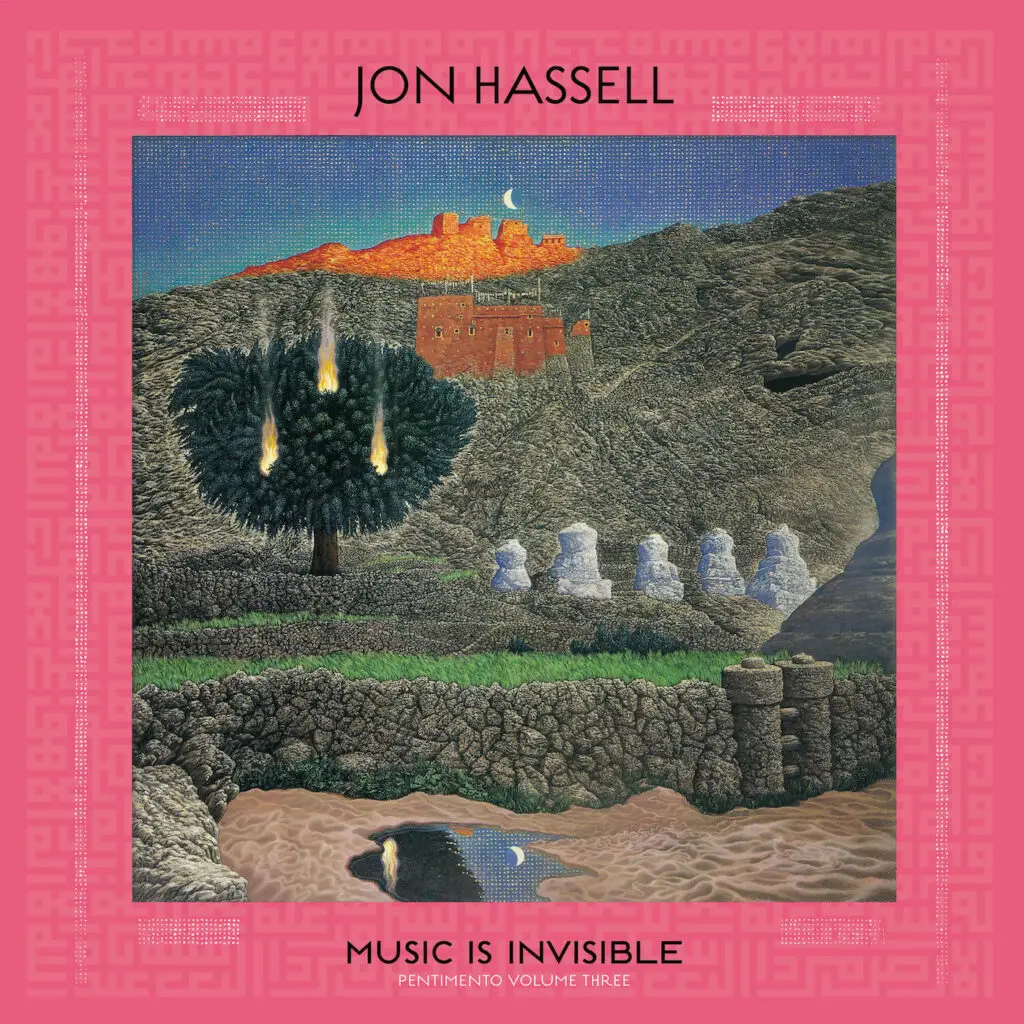
painting by Mati Kalrwein
When I try to figure out why some people luxuriate in a Gil Evans texture and others merely ‘enjoy’ it (or don’t get it at all), I think the term ‘musical literacy’ might apply too, i.e. the ability to combine the more usual mode of horizontal listening (what’s happening NEXT) with the more subtle psychological process of listening vertically (what’s happening NOW), where you let your
ears scan up and down the sonic spectrum being created in a given instant.
We may try to come as close as possible with word descriptions but that is essentially a language experience about a musical experience. Wherever this degree of fuzziness between ‘thing’ and ‘description of thing’ exists, opportunity knocks for a Babel of opinion – and marketing.
A critic says this is great or that’s not. That opinion becomes viral and you and your friends begin to buy into the media echo chamber, the big music corporations fan the flames by supplying those ‘missing’ visuals via music videos and movie soundtracks. Then — instead of having your own experience, your listening takes place inside the box of those images and those verbal descriptions.
My idea of the pleasure of – let’s call it ‘deep listening’ – involves a surrender to an interior soundscape that is beyond words, one that is kaleidoscopic and prismatic, that refracts everything that you’ve ever been thrilled by, be it Scriabin or Marvin Gaye, Ravel or Gil Evans, Couperin or Joao Gilberto, Javanese Gamelan or a folksong by a campfire.
But if your listening experience has been conditioned by the corporate music of today — a handful of well-worn templates of meaning (lyrics) set in a few well-worn templates of musical background (the verse-chorus form using the same 4-5 chords) — the shapes in your interior kaleidoscope will tend to be more familiar and somewhat monochromatic. Of course, with the right chemical boost, one can simulate that deep listening mode in experiencing most anything (see Magical Mystery Tours). But that’s just a trip, and that’s cool, there’s no reason to diminish that experience. But there’s so much more! So many new shapes…
What would it look like if all the best painters appeared in a show in which the work exhibited the same narrow range of variation as exists in the currently accepted category of popular music? A sameness that would appear shocking in the visual context.
SEMINAR 1: What is Vertical Listening?
SEMINAR 2: Around the question, “What is the musical equivalent of a Gaudi?”
This question highlights the issues in the essay above on the invisibility of music – asking those with a visual sensibility refined enough to appreciate the surreal, storybook aspect of Gaudi’s
architecture to also think about what in their musical universe is conceivably equivalent? All of us, including those of visual literacy and refinement, have grown up with a corporate-supplied background track to our adolescent years that loops forever in movies and television. Without a real effort at broadening the experience of music, they (we) have no idea of what a Gaudi could sound like in the imagination (Charles Ives? Ravel? Gamelan?). It’s this gap between visual and musical sophistication that is the subject here.
The kind of musical taste that has arisen in the corporate music sphere – if expressed in architecture – would be something like being a fan of the Top Ten façades of various fast-food franchises. Sure, that can be fun and instructive too but this attitude easily hardens into the acceptance of the ‘new normal’ – living in a world of irony, avoiding the deeply beautiful.
© 2013 Jon Hassell
TEXT FORWARDED FROM “THE DAILY PENNSYLVANIAN”:
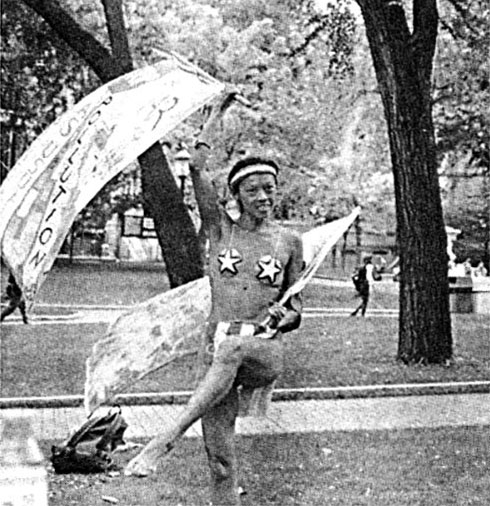
The following is the full of text of a note, directed at the Penn (U. of Pennsylvania) community, that was enclosed in one of the packages of materials that Kathy Change distributed the morning of October 22nd 1996, the day she set fire to herself.
(Note that this was written in the atmosphere surrounding the first Gulf War. -jh)
All that you have and cling to in fear
Is as worthwhile as a poisoned pie.
A universe full of love and wonderful possibilities
Would be yours if only you would reach for it.
You are sitting in timid conformity
On a hayride to hell.
You’re just about there.
Get off that truck now.
Break out of the ranks of evil
Do a dance for freedom.
I am angry, impatient, full of anxiety
And full of hope and love
But after 18 years of trying and being rejected
And being a pariah and a fool
I have finally concluded that my charism
And social magnetism register high on the negative scale.
Now that I’ve put in the first word,
This movement that I’ve tried to start,
Would probably do better without me,
So I will try to make a dramatic exit.
I’ve tried to do this several times before,
And failed.
If this is the right thing to do,
Heaven will help me.
If not,
Well,
Nevermind. I’ll be seeing you around.
I look at you and you are so beautiful
It makes me shy.
Your sympathy makes me want to hide
Because I feel unworthy.
For the cause I want to grab you
Drag you to meetings and demonstrations
But I’m afraid of putting you on the spot
Making you uncomfortable, scaring you away
So I am frozen in wanting
to merge my mind and heart with yours
Imprisoned by the invisible barriers
That I know must be broken through
I scream shrilly
I am an ungainly presence
Trying to break through the complacency
with my wild rage.
I have crashed this party
I do not belong here.
But you do. You are the children of the host.
You can talk to each other as peers
And take your rightful places
At academia’s table
with calm and gracious poise.
As crazy as I have been,
You can be cool.
Have confidence in your beliefs
You are a step ahead of everybody else.
Underneath their herd stupidity
Even the demo emulating morons and their sold out mentors
Who appear to be the majority in your milieu,
Are human beings
Who long for the world to be freed and set right
Even though they don’t know it.
Do them the great kindness of forgiving their stupidity
And put them in touch with the real heart
Of humanity.
To reach through the mask
Is your task.
There is so much at stake;
The country, the world, the future.
Don’t be put off by trivialities.
With you as its champion
Good will surely triumph.
How great will be your glory
How multitudinous will be your blessings
The highest happiness will be yours.
For many years I have though that Penn
Would be a good place to start the Transformation.
If this action I am taking succeeds
I hoped it might spark some interest
In what I was trying to say.
I hoped my writings would be printed and made available.
Maybe Transformation Parties could be held.
I am taking this action out of hope
Not despair.
By destroying my material corpus
I want to free my spirit
So that it can jump inside of you
I think that you would enjoy being filled
with conviction and can-do optimism
I think you would feel good
to be cleansed of the blase brain rot that clogs your mind
Yes there is such a thing as true morality, a real
distinction between good and evil, right and wrong.
Decisive moves must be made on behalf of good.
These are the addresses of some Penn people to whom
I have sent my packages.
Maybe you would like to meet and talk.
I have also sent packages to WXPN
and the Daily Pennsylvanian.
October 7, 1996
The multitudinous war crimes and crimes against humanity of the U.S. government have been documented and detailed, and every American is more or less aware of the criminality of his government, and yet we continue to respect its power and authority. We continue trying to work through the electoral process. We plead with our congress people to work for the well being of all the people and the planet instead of catering to the special interests of big money and organized crime. It is as though Gary Heidnik, the man who imprisoned, tortured and murder women in his basement, was the headmaster of a girls’ prep school; and upon discovery of his crimes,he was duly criticized, but allowed to remain in his position of power and responsibilty, presumably to continue his atrocities. The U.S. government is a much bigger and far worse criminal than Gary Heidnik, and it must be relieved of its duties immediately without further bureacratic hemming and hawing. The crimes of this present system are so enormous, an the dangers to which it is exposing us are so deadly and world threatening, that a sincere and forthright call to the American people to depose this evil system and come together now to peacefully replace it with true democracy, would be received with an overwhelmingly positive response from the people. Media workers are in a position to make this call and it is their responsibility to do so.
It is a waste of energy to get angry and gripe at the government. The government must be replaced by a truly democratic selfgovernment of, for and by the people. Those people working in industries essential to maintaining life should democratically take over their work places and organize an emergency economy to supply the needs of the people. The rest of the people should meet in their communities to organize a new directly democratic community based selfgovernment. This should be done immediately, because every day that we continue with business as usual, the problems just get worse. I want to protest the present government and economic system and the cynicism and passivity of the people in general.
I want to protest this entirely shameful state of affairs as emphatically as I can. But primarily, I want to get publicity in order to draw attention to my proposal for immediate social transformation. To do this I plan to end my own life. The attention of the media is only caught by acts of violence. My moral principles prevent me from doing harm to anyone else or their property, so I must perform this act of violence against myself. Around twelve years ago, I don’t remember the exact year, a woman from Boston set herself on fire in Independence Square. For the next five days the Philadelphia Inquirer was filled with reports of investigations into who this woman was and speculation as to why she did this act. Since I have been in Philadelphia for fiften years, all the while making myself very visible demostrating my position opinions, dancing and waving my flags on the streets of this city, I believe I should create at least as much as a sensation in the press. If the news media buries this story it will be proof of the extreme prejudice of the media. I want this statement and my other writings to be printed in the newspapers of this city. I want the people of this city who have been seeing me around for so long to finally hear what I’ve been saying. I want my ideas to be publically discussed. If people talked about my ideas, they would realize that transformation of our society is possible, and they would feel better.
I first planned to take this action a year ago. I wrote up final statements, xeroxed them, and then I backed down. A year ago, economic collapse seemed to be the most imminent danger threatening us. Today the likelihood of the impending war with Iraq rapidly escalating into a nuclear holocaust eclipses the likelihood of economic collapse as being by far the more serious and scary crisis. I am propmted to take this action by the dire urgency of the world’s environmental crisis, and the enormous unnecessary suffering and repression being endured by all the world’s people because of the oppressive geopolitical system. Of all the world’s people, only the American people have the power to change this global system of abuse, and therefore, it is their responsibility to do so. I hope my action will not be viewed as tragic, but rather, in the light in which it is intended. I am performing this ritual sacrifice in hopes that it will increase the efficacy of my prayers to all the people to have faith in the ideals, choose the path of peace and transform this nation and world.
I also want to make a statement about life and death. Death is natural and inevitable. Death is good, because it allows life to make a fresh start. The spirit is everlasting and always returns to life through rebirth. I am not certain exactly how this happens, but I believe that the spirit recycles itself somehow. It’s true that we are each special individuals whose lives are precious, but we are also part of a great spirit body, the universal collective spirit. By dying, we dissolve our individual ego personality and rejoin the spiritual totality, before returning to alife in a new body. It’s a completely wonderful process, and not sad at all, except perhaps for the people we leave behind, who may miss us. But there are so many beautiful people in the world, that they should not miss the departed for too long. There are always plenty of people around to love.
This society places too much emphasis on the unconditional sacredness of life. Anti-abortionists believe that it is more important to save life than to guarantee the quality of the life they save. This belief in survival as the highest priority contributes to the deterioration of the quality of life for everybody. When people do not practice birth control and all the babies are saved, then we overpopulate. We kill wild animal species, strip the earth of its forests and wilderness, and the planet becomes ecologically imbalanced and punishes us with environmental disasters. When there are more people than we can care for, the quality of life diminishes for everyone. A life is worth saving only if it is worth living. It could be argued that to live with physical handicaps and adversity may be good for spiritual growth. But to live in moral degradation is not good in any way. Because our society is so corrupt, unfair, environmentally destructive, and in a state of deterioration, rather than improvement, we are all living in a state of moral degradation. Our society is like a cancer on the planet. The goal is for everybody to improve, not to commit mass suicide.
For eighteen years I have been trying to urge people to throw off the corruption and go for the good, but I don’t see my efforts as being successful in any way, except that it’s given me something to do. I do not want to live off of this evil society any longer. My life is dependent on this society, and so I want to end my life. I demand that life must meet a standard of true morality or else it is not worth living. In Orwellian fashion, this society equates repression with morality. But in truth, repression of people who are only trying to enjoy themselves and not hurting others is utterly immoral. The real struggle is not between races, or classes. It is not people versus the elite.
The real struggle is between good and evil; between intelligent behavior and blind obedient conformity. Good is what promotes health and happiness. Evil is what causes deterioration and disease. If we choose good, it will be a triumph for everybody. Every person from the poorest to the richest, from the humblest to the most powerful, will gain. Everybody will discover real joy and peace of mind. The benefits will be so absolute that I cannot imagine any other outcome.
We are entering an age that will be as different from what came before as day is to night, or as summer is to winter. Throughout this passing age, humanity has had to work very hard at being constantly on the defensive, and prepared for war. Now as we dissolve the enmity, we can all relax and enjoy life.
As a plan my action, I think of all the things that might hinder it. What if the post office fails to deliver my press statements? What if someone stops me from carrying out my intentions? I don’t know if I will succeed, but I will drop this statement in the mail and proceed, trusting in fate to bring about whatever is meant to happen.
Call me a flaming radical burning for attention, but my real intention is to spark a discussion of how we can peacefully transform our world. America, I offer myself to you as an alarm against Armageddon and a torch for liberty.